The root of suffering
The Emotional Learning Model
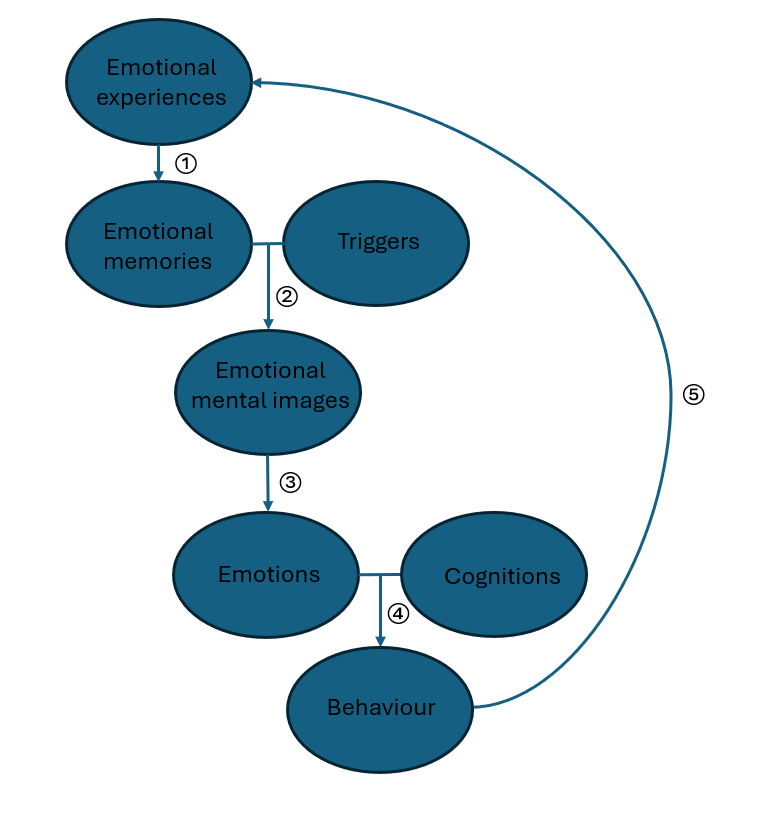
The base components in the Emotional Learning Model are emotional memories. These emotional memories are formed when emotional experiences are stored in memory (①).
The core principle in the Emotional Learning Model is that a trigger in the current situation generates new mental images for the person based on these emotional memories (②). This trigger can be something in the environment or an internal trigger and these mental images can be of the past or the future. These mental images also carry emotions and the type and strength of the emotions is based on the emotional memories. That’s how mental images cause a person to experience emotions in the current moment (③).
These mental images are not always single images. A single trigger can generate a whole cascade of mental images, with all the accompanying emotions. That explains why different people can react so differently to a situation: each individual has a personal history of experiences and therefore a personal collection of emotional memories. That means that the same situation can trigger very different emotional mental images for different people.
The generated emotions play an important role in the behavior of the person. Together with deliberate reasoning based on cognitions they shape the behavior of a person (④).
Of course, this behavior will lead to new experiences. These experiences can generate new emotional memories that will be integrated in the existing emotional memories (⑤).
What causes stressful emotions?
Let’s have a thought experiment: imagine sitting on a terrace in the sun on a beautiful spring day, with a meteor the size of a house approaching the terrace. In the here and now, until the meteor actually hits the terrace, there is no problem. Mental images that the meteor is going to destroy the terrace cause the emotions. The Emotional Learning model poses that this is the central mechanism behind stress. Except for situations when a person is in direct physical danger, without any mental images of past or future, there is no stress in the current moment.
Comparison with previous theories
Psychoanalysis – in Freud’s theory, there is a large role for the unconscious mind. In psychoanalysis, the therapist’s role is to learn about this unconscious and explain that to the client. In the Emotional Learning Model, the hypothesis is that an important part of this unconscious is available to the client. Because emotional mental images are fast it might require some training to get to know them, but getting to know them can be very helpful in understanding the cause of stress and how to solve it. Moreover, in this model there is no need for the therapist to interpret what the client shares. Because the images are available to the client and not the therapist, the role of the therapist is simply to help the client uncover these images.
Conditioning – in Skinner’s theory of operant conditioning, animals and humans learn through reinforcement and punishment. How this works inside the mind is not part of the scope of this theory. This theory provides great predictive quality with animals in the lab but is more difficult to apply to more complex human behavior. That is logical according to the Emotional Learning Model, because the emotional memories that influence behavior are very different from person to person. The hypothesis is that Emotional Learning Model explains how operant conditioning works inside the mind. Situations can trigger a whole cascade of mental images that is different per person. In a sense, the Emotional Learning Model can also be seen as “complex conditioning”
Cognitive Theories – Beck and Ellis created cognitive therapies. In their theories, events trigger thoughts and these thoughts cause emotions. The issue with this theory is that a thought like “I’m going to die” might have no emotional effect in one person, while it causes a lot of stress in the other person. The Emotion Learning model explains the difference between the two people. One person might not see mental images at all or see an image of him lying peacefully in his coffin. Another person might see images of being lonely in a nursing home, of going through a lot of pain or of going to hell after death. The thought itself is harmless, the mental images that accompany the thought are what cause stress or not. Cognitive therapy has been a great advance in psychology. Emotional Learning Model can be seen as going one level deeper. On the one hand, all the benefits of cognitive behavioral therapy are maintained in this model. The extra step makes it possible for each person to unravel the emotional foundations of their thoughts and through that help resolve emotional problems.
Therapy
Therapy in Emotional Learning Model is the process of readjusting the maladaptive emotional learning of the past. The emotional learning system is a result of evolution that helps people survive and prosper in the world. In every person, that system has created certain emotional reactions based on past experiences. In some situations, those emotional reactions are maladaptive. By readjusting the maladaptive emotional reactions, people can learn to experience the world without unnecessary stress.
This readjusting of maladaptive emotional learning can be done at different places in the model. The first option is targeting the strongest negative emotional memories and reducing the emotions that are connected to them. This is what happens in for example Imagery Rescripting and EMDR. These therapies go to the root of the problem, which explains their effectiveness.
Therapies like IR and EMDR address traumatic experiences. In the Emotional Learning Model, all emotional experiences create emotional memories. That means less traumatic events can also create maladaptive emotional memories. It would be interesting to find a way for people to reduce the emotional charge of less severe memories, preferably by themselves, without the help of a therapist. This would help enormously with the availability and cost-effectiveness of (self)-therapy.
Another option that has been proven to be effective is exposure therapy. By confronting a person with situations that he or she fears, the collection of emotional memories is changed in a way that makes the situations less stressful.
The third option is to work with the emotional mental images of past and future that arise from triggers in the current moment. How this can be done most effectively, is something to investigate further. There are a few ingredients that seem important:
- exploring the mental images. Because they are so fast, this might require some training. It is important to uncover the whole cascade of emotional mental images. Writing the images down can perhaps help to get a complete picture. Insight into which emotional mental images cause emotions can already be helpful.
- learning the relationship between the mental images and emotions. Learning that mental images cause emotions, not the outside world, can help handle the emotions and lead to more productive behavior. It can possibly help to imagine oneself in the stressful situation without experiencing the emotions.
- learning how to deal with situations / letting go of the results. In many situations, part of the stress is a result of not knowing how to deal with a certain situation and of not having control over the result. By learning what are good ways to deal with a situation, people can become more effective. However, the best way to deal with a situation will not always lead to the desired result. That makes it extra difficult to decide how to act. Learning the best way to act and letting go of the result will make it easier to make decisions and act in a productive way.
- a willingness to experience stressful emotions. Stress is a part of human life. A willingness to deal with emotions can help in dealing with stressful situations.
The current state of scientific research
The role of emotional memories and the effectiveness of trauma and exposure therapy are well known in the scientific community. The role of emotional mental images is acknowledged, but greatly undervalued. Understanding the role of emotional mental images will be a giant leap forward for psychology and for mankind.